James Hardie Garage Conversion ADU: The Riverside Owner’s Guide
We install and replace James Hardie siding, trim, and weather barrier components on garage conversion ADUs across Riverside, with most replacement jobs running $1,400 – $6,800 depending on the scope and how much underlying framing needs attention. That’s the honest range, and we’ll give you a written price before a single piece of Hardie board comes off the truck. You usually discover a problem the same way: a corner piece of trim has pulled loose after a Santa Ana wind season, or you spot water staining on the interior drywall near the bottom plate, or the paint on your HardiePlank lap siding is bubbling in a way touch-up paint won’t fix. The part itself matters less than what it was protecting, and that’s where most Riverside garage conversions we see run into real trouble.
Which James Hardie Models This Applies To
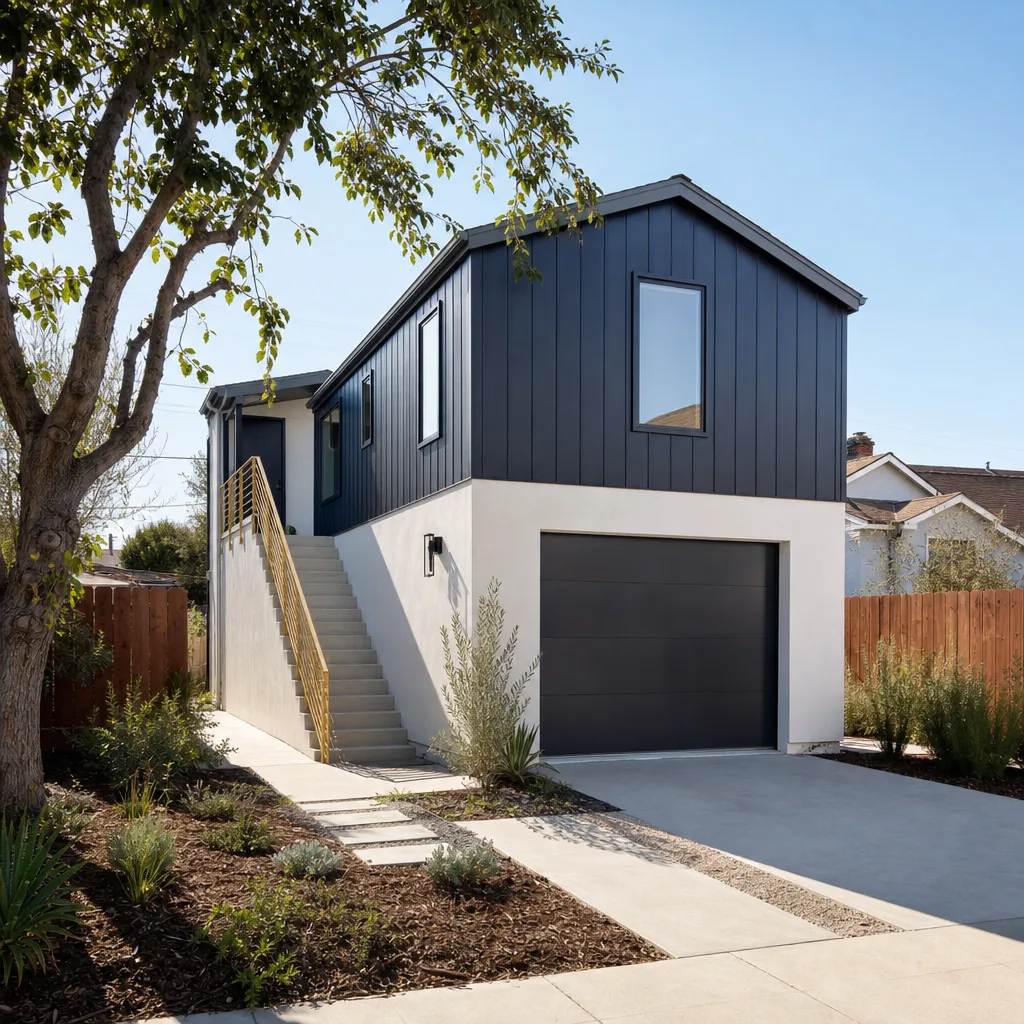
Garage conversions in Riverside typically use one of three James Hardie product lines, and the replacement part you need depends on which one you have. HardiePlank lap siding (the horizontal boards, usually 5/16″ thick, ranging from 4″ to 8-1/4″ exposure) is the most common on conversions built in the last 15 years. HardiePanel vertical siding (4’x8′ or 4’x10′ sheets) shows up on mid-century garage conversions and modern ADU builds alike. HardieTrim boards (5/4″ and 4/4″ thickness, smooth or woodgrain finish) handle corners, window surrounds, and the transition where your original garage wall meets the new ADU envelope.
Here’s a compatibility gotcha most Riverside homeowners don’t know: HardiePlank lap siding from before 2015 used a slightly different factory finish formulation, and color-matching a patch piece to pre-2015 siding is genuinely difficult. The new ColorPlus finish won’t fade at the same rate as your existing boards. When we see that situation, we usually recommend replacing the full affected elevation rather than patching, because a two-shade wall looks worse than the original problem. We also work with HardieBacker cement board for interior wet areas in garage conversions, which is a different product with different fastening requirements than the exterior siding lines.
On the aftermarket question: for James Hardie products specifically, we use OEM only. Hardie’s factory finish carries a 30-year warranty that aftermarket boards don’t have, and mixing aftermarket fiber cement with OEM creates expansion-joint problems in Riverside’s heat cycles. We stock HardiePlank lap siding in the three most common Riverside colorways (Navajo Beige, Monterey Taupe, and Timber Bark), plus Smooth HardieTrim in white and beige, on the truck. Anything else we order direct, usually 3 – 5 business days out.
Signs Your James Hardie Garage Conversion ADU Is Failing
- Interior water staining along the bottom 12 inches of drywall. This usually means the flashing between your slab and the first course of HardiePlank has failed or was never installed correctly during the original conversion. Water wicks up through the gap and the siding hides the damage until the drywall shows it.
- Corner trim boards separating from the wall plane. HardieTrim corners in Riverside take the brunt of thermal expansion. When the original installer used nails instead of the specified screws, or spaced fasteners wrong, the boards pull loose within a few years. You’ll see a gap you can fit a quarter into.
- Paint bubbling or peeling in an isolated patch, not all over. That’s trapped moisture behind the board, not normal sun wear. It means your house wrap or flashing behind that section has a breach, and replacing the siding without fixing the barrier is throwing money away.
- Siding boards that sound hollow when tapped. James Hardie fiber cement should sound like you’re tapping stone. A hollow sound means the board has separated from the framing or the original fasteners have corroded. In Riverside’s dry climate this is less common than in coastal zones, but poorly flashed window openings cause it.
- Visible cracking at the bottom edge of HardiePanel vertical sheets. If the original conversion didn’t leave the required 1/4″ gap between siding and the concrete slab, ground contact wicks moisture and the panel edge spalls and cracks. We see this on garage conversions where someone poured a new threshold or patio against the wall.
Replacement Cost & What’s Included
For a Riverside garage conversion ADU, here’s the line-item breakdown we give buyers:
- Isolated trim or siding patch (small area, no structural repair): $1,400 – $2,200 installed
- Full single-elevation siding replacement (typical 400 – 600 sq ft wall): $3,200 – $4,800 installed, including tear-off, barrier inspection, and new flashing
- Whole-structure re-side with HardiePlank and new corner trim: $5,200 – $6,800 depending on total square footage and elevation count
What drives the range in Riverside: the number of windows and doors requiring flashing rework, whether the original sheathing is sound or needs spot replacement, and whether the existing siding was nailed or screwed (screwed removal takes longer). Parts and labor are separate on every written quote we hand you. No change orders land silently on your final bill. The 365-Day Done Right Promise covers defects in workmanship for one full calendar year from project completion. If a piece of trim we installed comes loose in 11 months, we re-do it free.
DIY or Call Us?
Let’s be straight about the risk here. The siding replacement itself is not the dangerous part. What’s dangerous is what you find behind it. Riverside garage conversions from the 1980s and 1990s often have wiring run through exterior walls without conduit, and old conversions occasionally hid knob-and-tube remnants. Cutting into a wall cavity with a circular saw when you don’t know what’s behind the sheathing is how people get hurt. That’s the honest reason we don’t recommend DIY siding removal on older conversions.
What you can safely do yourself: document the damage with photos, measure the affected area, and check your paint can or permit paperwork for the original color name. That saves time when you call. What you shouldn’t do: pull boards off to “see how bad it is” without knowing where your electrical runs. If you’re unsure, call (831) 217-6083 and we’ll send someone to look. Miles Hartwell walks every Riverside site himself before we quote anything.
FAQs
James Hardie fiber cement siding on a Riverside garage conversion typically lasts 30 – 50 years before needing full replacement, but the factory finish and the flashing details usually fail well before the boards do. We replace trim and flashing on conversions built 15 – 20 years ago more often than we replace siding boards themselves. The board is tough; it’s the installation details around it that age first.
Yes, isolated section replacement is possible when the damage is confined to one or two boards and the underlying water barrier is intact; the catch is color matching on pre-2015 HardiePlank, which fades differently than today’s ColorPlus finish. If the damage traces back to failed flashing or missing house wrap, patching alone will fail again. Call (831) 217-6083 and we’ll tell you which situation you have.
A single-elevation replacement on a Riverside garage conversion ADU typically takes us two to three working days, including tear-off, barrier inspection, flashing correction, and new HardiePlank installation. Whole-structure re-sides run four to six days depending on weather and how much trim detail your conversion has. We’ll give you the schedule in writing before work begins.
We stock HardiePlank lap siding in the three most common Riverside colorways, Smooth HardieTrim boards, flashing stock, and HardieBacker for interior wet areas on our trucks, and we order specialty pieces direct from James Hardie with a 3 – 5 business day turnaround. If your color is in our truck stock, we can often start the same week you call. If we’re ordering, you’ll know that before you commit.
Written by Miles Hartwell, Owner, Sutton ADU Riverside at Sutton ADU Riverside, serving Riverside and nearby areas.