Last updated October 15, 2026
DIY vs Professional ADU: The Riverside Homeowner’s Decision Guide
California’s owner-builder law lets a homeowner act as their own general contractor on a primary residence, but here’s what almost every “DIY ADU” blog post skips: the rules change the moment the unit is intended for rent. An attached or detached accessory dwelling unit built under an owner-builder permit on a Riverside property carries restrictions that affect your ability to sell, refinance, or insure that structure for years afterward. This guide walks through exactly where the legal line sits, which tasks genuinely save money when you do them yourself, and which ones cost more than they ever return. For more guides & resources on ADU construction in the Inland Empire, explore our blog. We’re writing this from Riverside, where we’ve watched hundreds of homeowners make this call, and we’ll give you the numbers and the honest tradeoffs.
Quick Answer
DIY makes financial sense on an ADU for finish work only: demolition, insulation, painting, flooring, trim, and landscaping. You should not self-perform electrical, plumbing, HVAC, structural framing, or roof work on a Riverside ADU, especially one intended for rent, because owner-builder permits on rental ADUs trigger resale disclosure rules and lender scrutiny that erase any upfront savings. Most Riverside homeowners who partially DIY save $18,000 to $40,000 on a $220,000 detached ADU, while those who attempt full DIY spend more than hiring a contractor after correcting inspection failures.
Table of Contents
- California Owner-Builder Rules and the Rental Exception
- Task-by-Task Breakdown: Where DIY Actually Saves Money
- The Hidden Cost of DIY Timeline Extension in Riverside
- What Lenders and Insurers Actually Require for Owner-Built ADUs
- A Realistic Skill and Time Self-Assessment Framework
- Riverside Permit and Inspection Reality: What to Expect
- The Prefab and Modular Option: A Middle Path
- Common Mistakes to Avoid
- When to Call a Professional
- Frequently Asked Questions
- The Bottom Line
California Owner-Builder Rules and the Rental Exception
California Health and Safety Code Section 50651 allows a property owner to pull a building permit and act as the general contractor on their own primary residence. You can self-perform framing, drywall, painting, flooring, and finish carpentry without holding a contractor’s license. What you cannot self-perform under an owner-builder permit in California: any work requiring a separate trade license, which means electrical, plumbing, and HVAC. Those trades require a licensed contractor or, in limited cases, a homeowner who passes a specific exam through the Riverside County Building Department for electrical or plumbing on a primary residence only.
Now the part that matters for ADUs specifically. Under California Business and Professions Code Section 7044, the owner-builder exemption applies to structures that are “intended for occupancy by the owner.” The moment an ADU is planned as a rental, which is the overwhelming reason Riverside homeowners build them, the exemption narrows significantly. If you build an ADU under an owner-builder permit and later rent it, you are legally required to disclose the owner-builder status on any future sale, and you cannot sell the property for one year after completion without facing additional scrutiny from the California Contractors State License Board and potential liability claims from the buyer. That one-year rule is enforced via a disclosure that appears on the title record, and title companies here in Riverside flag it routinely.
There’s more. If a homeowner acts as owner-builder on an ADU and uses unlicensed labor for any trade that requires a license, the workers’ compensation insurance question becomes legally murky. We see this in La Sierra and Wood Streets neighborhoods where homeowners hire day labor for framing. When the Riverside building inspector asks for a workers’ comp certificate at the framing inspection and you can’t produce one, the project stops. No inspection, no progress, no permit sign-off. You can pull unlicensed-labor work out if caught early, but pulling it out and starting over often costs more than paying the licensed trade in the first place.
For Riverside properties specifically, the city follows the 2019 California Residential Code as amended locally, and Riverside’s building department is known among contractors for strict structural inspections on ADU foundations and shear wall nailing. DIY work that passes in unincorporated Riverside County may fail in the city because Riverside requires a deputy inspector for certain concrete pours and pre-drywall structural reviews. We tell every homeowner considering owner-builder that’s not fear-mongering, it’s scheduling reality. Inspectors hold the power, and they will not rush a failed re-inspection to accommodate your timeline.
Task-by-Task Breakdown: Where DIY Actually Saves Money
This is the map. We’ve built it from watching Riverside projects on both sides: fully contracted, fully DIY, and the hybrid that works best for most homeowners. The hybrid is where you save real money. Trying to self-perform licensed trades is where you lose it.
Tasks Where DIY Saves Real Money (Low Risk, No License Required)
- Demolition. If you’re converting a garage or tearing out an old patio cover, demolition labor runs $3 to $6 per square foot through a contractor here in Riverside. Renting a dumpster and doing it yourself costs about $600 to $900 total for a typical two-car garage tear-out. This is the single best DIY value on the whole project, with one caveat: stop before you touch any load-bearing wall.
- Insulation. Batting fiberglass into floor joists and wall cavities is genuinely learnable in a weekend. Contractor-installed insulation costs $1.50 to $3.00 per square foot in the Inland Empire. Material cost is $0.50 to $0.90 per square foot. You save $1,200 to $2,400 on a 400-square-foot ADU. Wear long sleeves, a mask, and gloves. It’s uncomfortable, not dangerous.
- Painting. Interior painting for a 400-square-foot ADU quoted by a licensed painter in Riverside runs $3,500 to $6,000. Materials cost $400 to $700 for quality paint and supplies. This is not a contested opinion; the labor arbitrage is real and the risk of failure is low. Repainting a bad paint job costs you a day and $150 in materials.
- Flooring. Luxury vinyl plank and laminate click-lock systems are genuinely DIY-friendly. They go down over flat subfloor with a utility knife and a rubber mallet. Labor savings here run $2 to $4 per square foot, or $800 to $1,600 for a 400-square-foot ADU. Engineered hardwood is harder but still learnable. Solid hardwood and tile: leave to the pros.
- Landscaping and hardscape. Riverside’s climate zone 9b means drought-tolerant planting, decomposed granite paths, and simple drip irrigation are all DIY-viable. Planter beds and mulch work save $2,000 to $5,000 against landscape contractor quotes. The key is not stepping into anything involving gas line trenching or drainage that ties into the city storm system.
- Finish trim and hardware. Baseboards, door casing, cabinet pulls, door hardware, and closet shelving are all low-stakes, high-savings tasks. None of these fail an inspection and all of them absorb contractor markup.
Tasks Where DIY Creates Inspection Failure and Insurance Voids (High Risk, License Required)
- Electrical. A licensed electrician pulls the permit, Rough electrical inspection happens before drywall closes walls, and your homeowners insurance won’t cover a fire claim traced to unpermitted or self-performed electrical work. We have seen this exact scenario with a homeowner in Orangecrest whose insurance claim on a panel fire was denied because the panel was self-wired. Replacing the panel, rewiring, and repairing the damage cost more than the entire electrical budget for a hire from the start.
- Plumbing. Gas lines, sewer connections, water supply, and drainage all require a C-36 plumbing license. A failed plumbing inspection on a leak means tearing out walls, which means rework on drywall, paint, and trim you already finished. The risk compounds quickly. Riverside Water requires specific backflow prevention and water meter configurations for secondary dwelling units, and the inspector will check for them.
- Structural framing. This is the one that trips DIY owners hardest. Shear wall hold-downs, engineered beams, roof truss connections, and foundation anchor bolts are all structural items that follow a specific engineering plan stamped by a California licensed engineer. If the inspector sees staggered nailing patterns that don’t match the plan, the correction note is not a suggestion. You are now hiring a framing contractor to fix what you already paid time and material to build wrong.
- HVAC. Mini-split systems are physically installable by a handy homeowner, but the refrigerant line set must be charged by an EPA-certified technician. If you self-install and the system leaks, you’ve voided the manufacturer warranty and the energy load calculations required for California Title 24 compliance don’t get you any credit for a self-installed system.
- Roofing. Riverside’s summer heat and occasional Santa Ana winds mean roof work is not just legally ill-advised, it’s dangerous. Falls from roofs are one of the top causes of construction fatalities. We won’t give step-by-step instructions here because the risk of a homeowner on a hot Riverside roof in August outweighs any labor savings. Hire a licensed C-39 roofing contractor and sleep at night.
- Concrete foundations and flatwork. Riverside’s expansive clay soils in parts of the city require specific preparation and reinforcement. A poured slab that’s 2 inches too shallow or missing the required vapor barrier fails inspection and gets jackhammered out. This is not a DIY task and the rework cost makes that clear.
The Hidden Cost of DIY Timeline Extension in Riverside
Most DIY cost analyses treat your labor as free. It is not free. It’s time you are not earning rent, not working your day job, and not living in a finished home. Here’s the math Riverside homeowners should run before choosing DIY for anything beyond finish work.
A professionally managed detached ADU in Riverside, from permit application to final inspection, runs 8 to 14 months, depending on site work, plan check turnaround, and the city’s current staffing. A fully self-managed owner-builder ADU on the same lot runs 18 to 36 months when the owner works weekends and evenings while holding a full-time job. That’s not an exaggeration. We have watched owner-builders in Mission Grove and Canyon Crest hit the two-year mark and still be fighting drywall mud cracks.
Let’s put dollars on that gap. A one-bedroom ADU in Riverside rents for $1,800 to $2,400 per month in the current market. Eighteen extra months of DIY timeline is $32,400 to $43,200 in lost rental income. If you financed the project with a construction loan or HELOC, every extra month carries interest. On a $220,000 draw at 7%, that’s roughly $1,280 per month in interest-only carrying costs. Across an 18-month delay, you’re at $23,040 in pure interest before a single correction order. Now compare the $30,000 to $45,000 you thought you were saving on general contractor markup. The math quietly collapses.
Riverside-specific costs deepen the penalty. Building permit fees run $8,000 to $18,000 for a detached ADU here, depending on square footage and school district impact fees, which are collected at permit issuance for ADUs over 500 square feet. If your permit expires, which happens at 180 days of no inspection activity, you pay reactivation fees. School district fees are non-refundable, so if you let the permit lapse, that money is gone. A contractor managing the schedule keeps the inspections moving, which keeps the permit alive. An owner-builder who stalls loses both the fee and the momentum.
Then there’s the physical reality of Riverside’s climate. The best building window is October through June. Start demo in July and you’re laying foundation forms in 105-degree heat. Owner-builders who plan around their own schedule often miss the window and spend a summer stalled by heat restrictions on concrete pours and the fatigue of working weekends in the Inland Empire sun. Contractors schedule for this automatically. DIYers learn it the hard way.
What Lenders and Insurers Actually Require for Owner-Built ADUs
This is the quiet liability most DIY ADU guides never mention. The financial institutions that back your property care deeply about who built the square footage. Here’s what they look for.
When you refinance or sell a property with an owner-built ADU in Riverside, the lender’s underwriter will ask for several documents: the final signed permit card from the City of Riverside building department, the certificate of occupancy, and often a foundation certification and structural engineer’s letter. If any of those is missing, the ADU is classified as unpermitted space, and its square footage and rental income are simply not included in the appraisal. Some lenders will refuse to finance the property altogether. You don’t get to argue the ADU is “basically permitted.” It either has the paper trail or it does not.
For homeowners insurance, the math is equally blunt. If electrical or plumbing work was self-performed and later causes a claim, the adjuster will look for a permit and a licensed contractor’s record. No license, no coverage. If an unpermitted water heater floods the apartment and damages the tenant’s belongings, your landlord policy may not cover the liability. In California, tenant lawsuits against landlords are common enough that every insurance broker in Riverside will tell you the same thing: unpermitted work is the fastest way to lose coverage.
Resale disclosure deserves its own paragraph, because it’s the sleeper. California Civil Code Section 1102 requires sellers to disclose any structural modifications made without permit or under owner-builder status. When you sell a Riverside home with an owner-built ADU, the disclosure goes to the buyer in writing. The buyer’s agent will use it to negotiate down the price, the buyer’s lender may refuse to lend, and the buyer may walk entirely. We have seen owner-built ADUs cost sellers $40,000 to $60,000 in sale price reductions because the disclosure created doubt that the structure was sound. The savings from self-performing electrical and plumbing evaporate, and then they invert into a loss.
One more: if you used unlicensed workers for any portion of the build and someone was injured, you as the property owner are liable. A contractor carries workers’ compensation insurance. You, as an owner-builder, carry that risk personally. In Riverside, where ADU construction is booming, this is a live concern, not a hypothetical.
A Realistic Skill and Time Self-Assessment Framework
“Handy” is not a useful filter for this decision. The useful filter is whether you have managed permits, scheduled inspectors, coordinated subcontractors, and read a construction schedule before. Here’s a five-part self-assessment that predicts success more accurately than any “are you handy” quiz.
- Permit navigation experience. Have you ever filed a building permit application, responded to a plan check correction letter, or paid impact fees? If the answer is no, the Riverside plan check process will consume your first 60 days and probably more. The city’s current plan check turnaround for ADUs runs 4 to 10 weeks after the new state-mandated 60-day review window. Every correction cycle adds 2 to 4 weeks. A contractor answers correction letters within a day or two. A first-time owner-builder stares at the language and Googles “what does ‘provide shear schedule’ mean.”
- Subcontractor management experience. Have you ever coordinated three or more tradespeople on a single project? Not hired a handyman. Coordinated a foundation contractor, a framer, a roofer, an electrician, and a plumber on a shared schedule. The general contractor’s core value is sequencing. If the framer arrives before the foundation passes inspection, you pay the framer a day rate to stand around. If the drywall crew shows up before the electrical rough inspection is signed off, you pay twice for the same work.
- Riverside inspection scheduling competence. Riverside building inspections are scheduled online through the city’s portal. Inspectors give two-hour windows. If you work a full-time job, you’ll need to take days off for inspections you didn’t know were required. A contractor has a runner or office person handling this. You will personally lose workdays to inspection windows, and every missed window pushes the permit clock.
- Budget tolerance for correction orders. When a Riverside inspector writes a correction note, you fix it and schedule a re-inspection. If the correction is beyond your skill, you hire someone. That hire carries a premium because the contractor is fixing another person’s error. If your budget is exactly the construction quote with no cushion for rework, you are not a candidate for owner-builder on anything structural.
- Physical stamina and schedule consistency. ADU finishes cannot be done in random free weekends over a year. Paint needs to be applied in a continuous run. Drywall mudding needs consistent humidity and scheduling. Flooring transitions need to happen before trim, not after. If you have two weeks off work and then no time for a month, the project stalls and the permit clock runs.
If you answered no to more than two of these, do not act as your own general contractor. Do the finish work. Hire the rest. That’s the hybrid that actually saves money in Riverside, and it’s what we’ve recommended to hundreds of homeowners over nearly two decades of building here. If you’re considering a larger project, see our Home Addition Contractor Maintenance Checklist for Riverside Homeowners.
Riverside Permit and Inspection Reality: What to Expect
Riverside’s building department has specific quirks that shape the DIY conversation. Understanding them before you choose a path saves months and thousands of dollars.
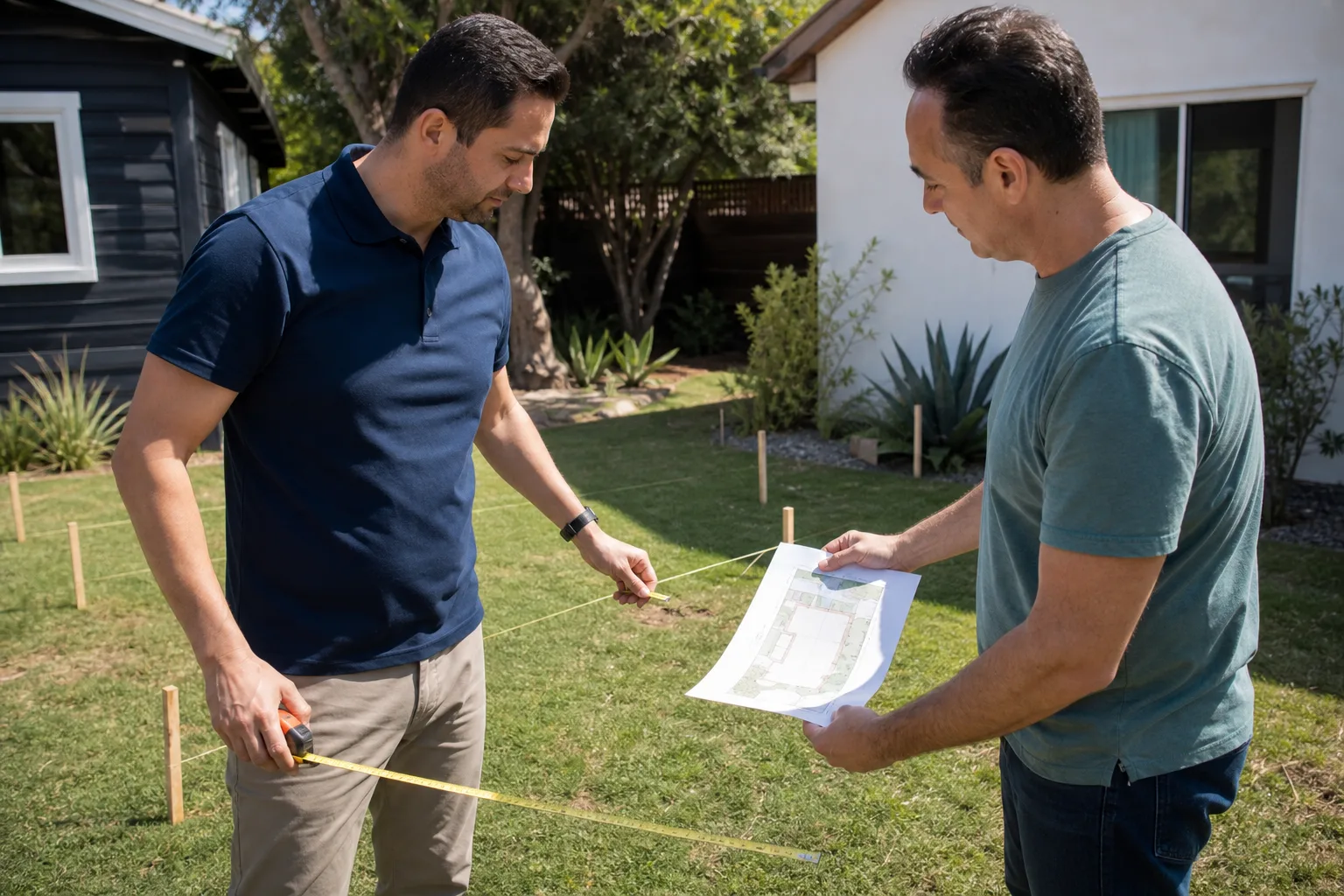
First, ADU plan check. California Senate Bill 9 and the state’s ADU acceleration laws require Riverside to respond to ADU permit applications within 60 days, but that response can be a correction letter, not an approval. Most first-time ADU submittals in Riverside get two to three rounds of corrections. Each round takes 2 to 4 weeks for the city to review. A contractor who submits clean plans gets through in 60 to 90 days total. A homeowner who submits incomplete plans can spend 6 to 9 months in plan check alone. This is the single biggest hidden timeline cost in the entire process, and it occurs before any physical work starts.
Second, inspection sequencing. Riverside requires inspections at specific points: pre-pour foundation, under-slab plumbing and electrical, shear wall and hold-down before drywall, rough electrical and plumbing before insulation, lath and scratch coat for stucco, and final. Each inspection requires the previous one to be signed off. If you self-perform drywall and the inspector finds an unmarked junction box, which happens when a homeowner buries a splice behind sheetrock, you’re cutting open your own finished wall to expose the box. That rework cost is not covered by any savings.
Third, deputy inspections. Riverside requires a deputy inspector for certain structural and concrete work on ADUs: rebar placement, hold-down installation, and pour observation. The deputy is a third-party inspector hired by the engineer of record, paid for by the homeowner. A contractor arranges this automatically. An owner-builder is responsible for scheduling it and understanding when it applies. Miss the deputy and the city inspection fails.
We should also mention ADU Builders in Riverside here, because if you’re reading this and feeling the weight of the permit process, that’s the point of this section. The permit path is navigable, but it rewards experience. The Sutton ADU Riverside home page has more detail on how we handle the front end for homeowners who want no part of plan check.
The Prefab and Modular Option: A Middle Path
Somewhere between full DIY and full custom build sits a third option that Riverside homeowners frequently overlook: prefab and modular ADU systems. Not sure where to start? Read our guide on How to Hire a ADU Contractor in Riverside: A Step-by-Step Guide. Brands like Abodu and Cover have model families that are partially or fully assembled offsite and then set on a Riverside lot. This changes the DIY calculus in interesting ways.
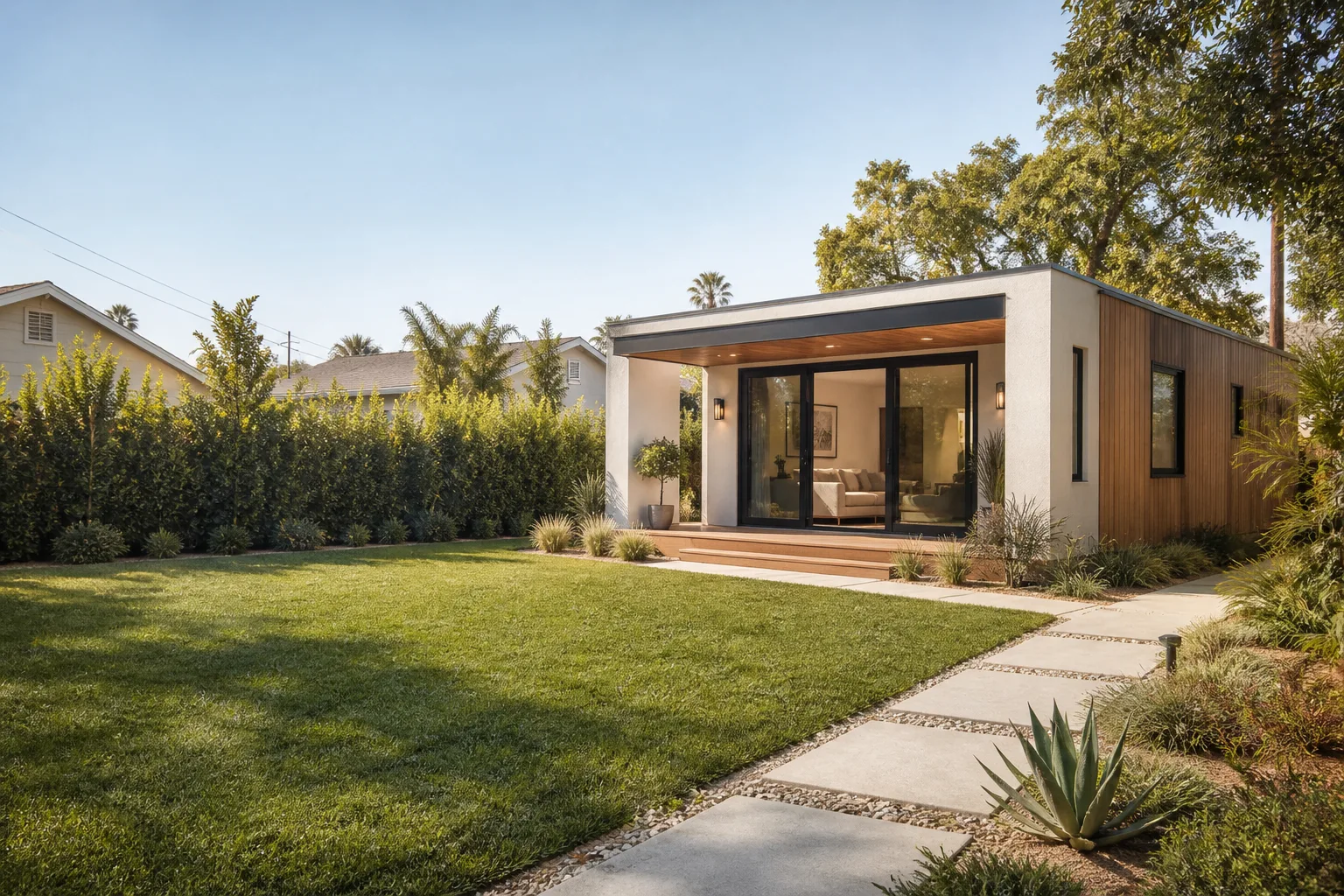
With a prefab like Abodu, which builds in a factory and delivers to the site, much of the work that tempts DIY, framing, insulation, drywall, finishes, happens offsite under factory quality control. The homeowner’s decision narrows to site work: foundation, utility connections, and permitting. Those are exactly the tasks where DIY fails most often. A prefab unit doesn’t eliminate the need for permits, trades, and inspections, but it compresses the onsite timeline from 8 to 14 months down to 4 to 6 months in many Riverside cases. Tuff Shed conversions take this further: a prefabricated structure that arrives assembled and gets converted into a livable ADU with insulation, electrical, and plumbing installed by licensed trades.
Where does this fit the DIY framework? If your goal is to self-perform finish work only, a Tuff Shed conversion or a simple prefab like Abodu’s smaller models gives you a weathertight shell quickly, then you paint, floor, and trim. If you’re comparing full-custom construction, a prefab system often lands 15% to 25% under a stick-built quote for a comparable finish level. That’s not a claim every builder in Riverside will make, but the factory economy is real, and it’s why we work with Abodu, Cover, and Tuff Shed packages as options for homeowners whose budget is tight and timeline is relevant.
The tradeoff is design flexibility and site adaptability. Prefab modules are limited by road transport dimensions and crane access. Riverside lots on hillsides, which are common in neighborhoods like Alessandro Heights, may not accommodate a crane set. Flat lots in the city’s newer subdivisions are ideal. We tell every homeowner to get a site feasibility review before committing to a prefab path, and that’s a free conversation, not a sales pitch.
Key Takeaways
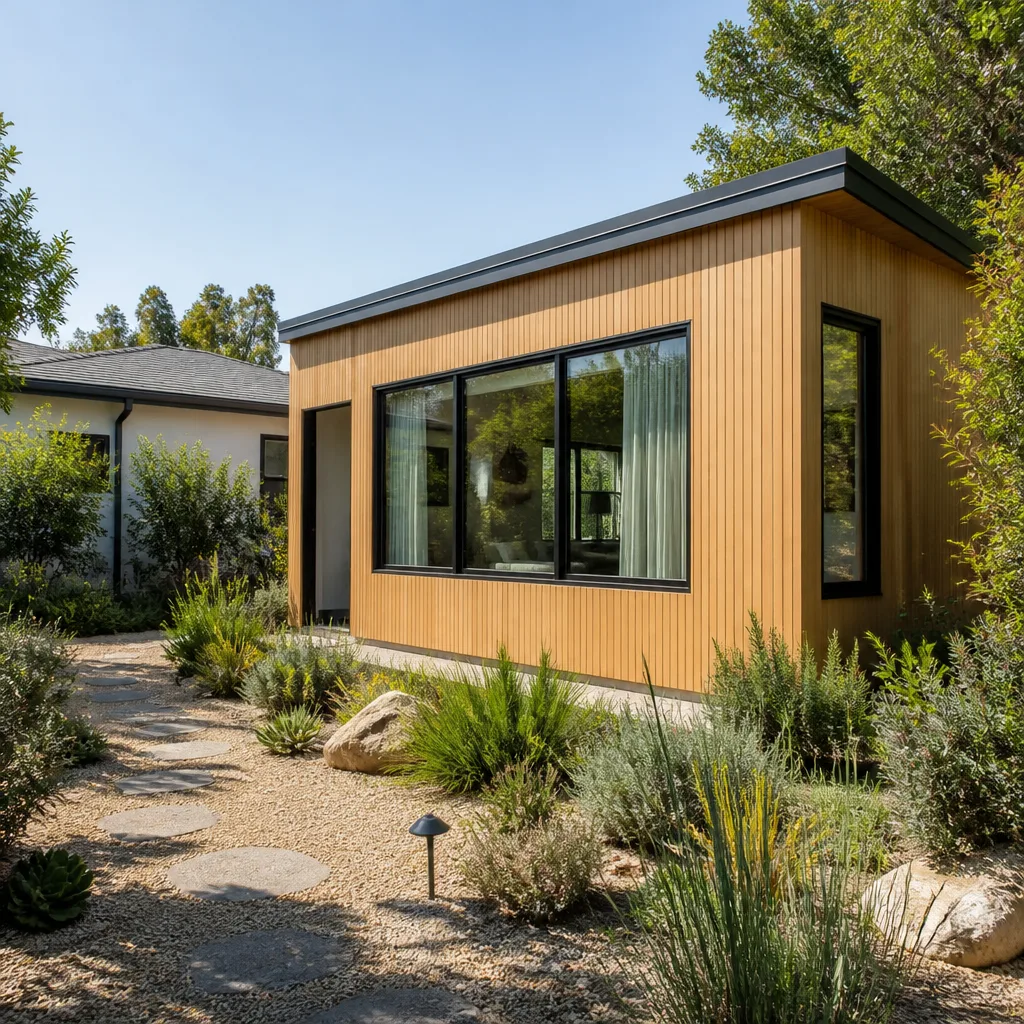
- The owner-builder permit path exists, but renting the ADU changes the disclosures and liability you carry for years.
- DIY saves money on demolition, insulation, painting, flooring, and landscaping. It loses money on electrical, plumbing, framing, HVAC, roofing, and concrete.
- The DIY timeline penalty, lost rent plus interest, often exceeds the contractor markup homeowners were trying to avoid.
- Lenders and insurers can exclude or deny coverage for owner-built or unpermitted ADU work. The paper trail is the asset.
- Prefab systems like Abodu, Cover, and Tuff Shed conversions offer a middle path that reduces onsite DIY risk while keeping costs lower than full custom.
- Riverside’s inspection process is strict, scheduled in two-hour windows, and unforgiving of errors buried behind drywall.
Common Mistakes to Avoid
- Pulling the permit as owner-builder without reading the rental disclosure rules. Many Riverside homeowners start the DIY path thinking the permit is the only paper that matters, then discover at refinance or sale that the owner-builder disclosure creates a legal obstacle. Know the disclosure before you commit.
- Burying electrical splices behind drywall. Every splice must remain accessible in a junction box. Riverside inspectors fail rough-in when they find buried splices, and the fix means opening walls you already closed. Mark your boxes before you insulate.
- Letting the permit expire. Riverside permits lapse after 180 days without inspection activity. Reactivation costs hundreds in fees and restarts the review clock. Book at least one inspection every 90 days on a DIY build, even if it’s just a rough-in check on a small section.
- Underestimating plan check rounds. Homeowners routinely budget two months for permit approval and get six or seven. Plan for three correction cycles minimum if you’re self-managing the permit.
- Hiring unlicensed labor for licensed trades. The short-term savings vanishes the moment the inspector asks for a workers’ comp certificate or a license number. In Riverside, hiring unlicensed workers for framing, electrical, or plumbing also puts the entire permit at risk of revocation.
- Starting in summer. Riverside’s July and August heat makes concrete work, roof work, and painting genuinely hazardous. If your timeline puts you on a roof in August, reschedule. Heat stroke doesn’t save money.
- Skipping the soils report. Parts of Riverside have expansive clay soil that moves with moisture. A foundation poured without a soils report from a geotechnical engineer can crack within two years. This is one of the most expensive DIY omissions we see, and it’s entirely preventable.
When to Call a Professional
Call a professional when the task involves a licensed trade, a structural element, or a permit inspection you cannot pass on your own. If you’ve read this guide and realized the rental disclosure, the inspection scheduling, or the subcontractor coordination is not something you want to manage, that’s the answer you were looking for. Sutton ADU Riverside offers free estimates in Riverside, and we’ll walk your lot, explain the permit path that applies to your specific property, and give you a written price before any work starts. Call (831) 217-6083 if you want the conversation.
Frequently Asked Questions
Yes, you can act as owner-builder for portions of the work on your primary residence, including finish tasks like insulation, painting, flooring, and trim. You cannot legally self-perform electrical, plumbing, HVAC, or structural framing without the relevant license, and if the ADU is intended for rent, the owner-builder path carries specific resale and disclosure restrictions. Call (831) 217-6083 for guidance on your specific Riverside property.
Most Riverside homeowners who partially DIY save $18,000 to $40,000 on a detached ADU by self-performing demolition, insulation, painting, flooring, and landscaping. Homeowners who attempt full DIY often spend more than a professional build because correction orders, rework, and permit delays erase the savings. The real savings is in the hybrid, not the all-in approach, and it’s worth calling (831) 217-6083 for an estimate that reflects what you plan to self-perform.
The biggest hidden costs are lost rental income and loan interest during the extended timeline. A detached ADU in Riverside rents for $1,800 to $2,400 per month, and a DIY build often runs 18 to 36 months versus 8 to 14 months for a professional build. The gap can exceed $60,000 in lost income and carrying costs, which can be more than the contractor markup. Call (831) 217-6083 for a written timeline estimate on your project.
Insurance usually covers self-performed work only if the work was permitted, inspected, and passed. If electrical or plumbing was self-performed without a licensed contractor and later causes a claim, the adjuster may deny coverage. For landlord-tenant liability, unpermitted or owner-built work creates additional risk. Call (831) 217-6083 to discuss how your planned work affects insurance before you begin.
Yes. California Civil Code Section 1102 requires sellers to disclose structural modifications made under owner-builder status. The disclosure goes to the buyer in writing, and it frequently leads to price renegotiations, lender complications, or lost sales. The disclosure obligation is permanent and follows the property. Call (831) 217-6083 before pulling an owner-builder permit if resale value matters to you.
Demolition is the best starting task: it’s low-risk, saves $3 to $6 per square foot in labor, and requires no license. Insulation and painting follow as the next-best DIY values. Avoid any task behind an inspection wall, because failed inspections on electrical or plumbing force you to reopen finished work. For a full walk-through of your planned DIY scope, call (831) 217-6083.
The Bottom Line
The DIY-versus-professional ADU decision in Riverside is not one choice but a series of task-by-task judgments. Finish work is where DIY earns its place: demolition, insulation, painting, flooring, trim, and landscaping. Licensed trades, structural work, and permit management are where DIY costs more than it saves, especially on a unit intended for rent. The homeowners who come out ahead are the ones who understand the owner-builder disclosure rules before they pull the permit, who budget for Riverside’s plan check and inspection realities, and who protect their resale and insurance position by hiring licensed trades where it matters. For ongoing maintenance tips, see our Seasonal ADU Care for Riverside: Year-Round Homeowner’s Guide. That hybrid path saves real money without betting the house on it. If you’re ready to map your own line, we’d rather give you honest numbers over a free conversation than watch you guess. Call (831) 217-6083 and we’ll walk the lot with you.
Written by Miles Hartwell, Owner at Sutton ADU Riverside, serving Riverside since 2006.