Last updated October 15, 2026
How to Hire a ADU Contractor in Riverside: A Step-by-Step Guide
Riverside’s ADU market is moving fast. The city processed a 31% jump in ADU permit applications in a single recent year, and every surge like that pulls unqualified operators out of the woodwork. California’s Contractors State License Board consistently logs a spike in unlicensed contractor complaints right after ADU demand climbs. Here’s the part nobody tells you: most ADU projects don’t go sideways because of bad craftsmanship. They go sideways because the person who sells you the job isn’t the person who shows up to build it. This guide walks you through a vetting sequence that filters out that exact risk at every stage, so by the time you sign, you know precisely who you’re signing with. For more guides & resources on ADU planning, explore our blog.
Quick Answer
To hire an ADU contractor in Riverside, verify their CSLB license and insurance first, then require a written scope of work with a fixed price, demand crew-identity disclosure in the contract, and tie payments to inspection milestones rather than calendar dates. The contractor who answers your vetting questions directly and puts answers in writing is worth more than three bids from contractors who won’t.
Table of Contents
- Step 1: Verify the CSLB License in Under Five Minutes
- Step 2: Why Three Bids Matter Less Than One Detailed Scope of Work
- Step 3: The Three Contract Clauses That Protect You on an ADU
- Step 4: Verifying the Crew Before Day One
- Step 5: Red Flags That Show Up During Bidding
- Step 6: Riverside-Specific Rules and Realities
- Step 7: What ADUs Actually Cost in Riverside Right Now
Step 1: Verify the CSLB License in Under Five Minutes
Go to the Contractors State License Board website, click “Check a License,” and type in the contractor’s name or license number. That part takes thirty seconds. What you’re looking for takes another four minutes. The license must be active, the classification must cover residential building (Class B General Building is what most ADU contractors in Riverside carry), and the workers’ compensation insurance status should show as current if they have employees. If the contractor claims to be a sole proprietor with no employees, they can legally show no workers’ comp, but that means any injured worker on your property falls under your homeowner’s insurance. Ask about that directly.
Here’s what the CSLB lookup tells you: whether the license exists, whether it’s active, whether there are disciplinary actions or suspensions on record, and whether the bond is current. The bond is the contractor’s minimum $25,000 guarantee to consumers under California law. Here’s what the lookup does not tell you: whether the contractor actually manages their own crews, whether they’ll substitute different workers than the ones you met, and whether they’ve been sued in civil court without a CSLB action. None of that appears on the license page.
We tell Riverside homeowners to treat CSLB verification as the floor, not the ceiling. It eliminates the obvious bad actors. It does nothing about the contractor who holds a valid license but runs five crews and can’t tell you who will be on your lot next Tuesday. The next three steps handle that problem.
Step 2: Why Three Bids Matter Less Than One Detailed Scope of Work
The conventional advice is “get three bids.” That advice is incomplete. Three bids with three different scopes of work are three different projects wearing the same name. One bidder prices a 900-square-foot detached ADU with Hardie plank siding and a mini-split system. Another prices the same ADU with vinyl siding and a wall furnace. Both quotes land in your inbox as “detached ADU – $210,000” and “detached ADU – $245,000.” You’re comparing oranges to tangerines and calling it due diligence.
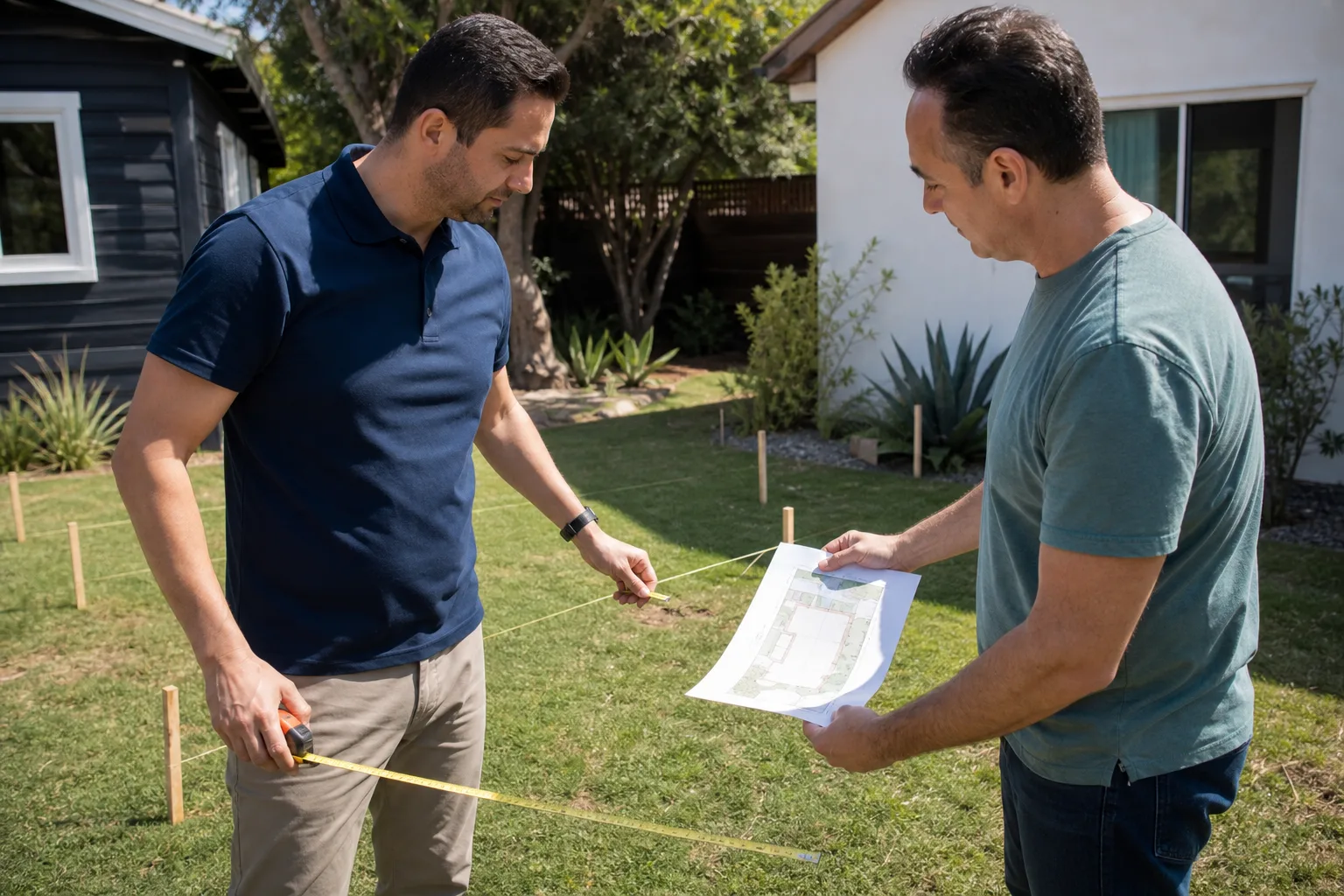
The better move: get one detailed, line-item scope of work from the contractor you’re most likely to hire, then stress-test it with pointed questions. A line-item scope lists every trade, every material category, every allowance, and every exclusion. It shows you the contractor’s assumptions. Here are the questions that reveal whether the scope is real:
- “What does this price include that other contractors typically leave out?” A good contractor in Riverside will immediately mention things like utility trenching, plan check fees, or the required fire-rated separation for a garage conversion. A vague one will say “everything you need.”
- “Which line item is most likely to change, and by how much?” Every honest ADU contractor knows which parts of a Riverside project carry uncertainty. If they say “nothing ever changes,” walk away.
- “What’s excluded?” If the answer is “nothing,” push harder. Landscaping restoration, painting touch-ups, and fence repair are commonly excluded. That’s fine if you know about it. It’s a surprise invoice if you don’t.
- “Who pulls the permit, and is the permit fee in this price?” In Riverside, the permit fee is a real line item, and the answer should be specific.
One detailed scope, asked the right questions, tells you more than ten thin bids. It tells you whether the contractor thinks in systems or in survival. The contractor who can explain their assumptions is the contractor who can manage your project.
Step 3: The Three Contract Clauses That Protect You on an ADU
California law requires written contracts for home improvement projects over $500, so you’ll get paperwork regardless. The question is whether the paperwork protects you or protects the contractor. Most standard contracts do a fine job outlining what gets built. They do a terrible job answering the three questions that actually determine whether your ADU project in Riverside stays on budget, on schedule, and under control.
Clause 1: Change-Order Limits. A change order is the formal document that modifies the scope and price after the contract is signed. Some change orders are legitimate, like discovering a drainage issue when you dig the foundation. Others are scope creep by another name. Your contract should state that any change order over a certain dollar amount or percentage of the total contract price (say, 5% or $10,000, whichever is lower) requires your written approval before the work proceeds. This prevents the slow accumulation of “small” changes that turn a $250,000 ADU into a $290,000 ADU without you ever having a single conversation about the total.
Clause 2: Crew-Identity Disclosure. This is the clause almost no one has and everyone should. It states that the contractor will provide, in writing, the names of the lead carpenter or project lead assigned to your job before construction begins, and that any substitution requires your prior written consent. It also states that all workers entering your Riverside property will be background-checked employees or licensed subcontractors, not day laborers recruited from a parking lot that morning. If a contractor’s face changes when you ask for this, you’ve learned something important before spending a dollar.
Clause 3: Phased Payments Tied to Inspections. The standard contract schedules payments by calendar date or by percentage of “completion,” which is a meaningless word that the contractor defines for themselves. Your contract should tie payments to objective milestones: permit issued, foundation poured and inspected, framing inspected, rough-in inspections passed, drywall complete, final inspection approved by the city of Riverside. Each payment happens when an inspector signs off, not when a calendar page turns. This keeps your project moving and keeps your money protected.
Step 4: Verifying the Crew Before Day One
You’ve verified the license. You’ve locked down the contract clauses. Now ask the question that determines who actually comes to your property: “Who is my lead, and how will I know them?”
Here’s what a straight answer sounds like: “Your project lead is Marcus R. He’s been with us for four years. I’ll email you his name and photo before we start. He’ll be the one in the marked truck, and he wears a photo ID badge. If we need to bring in a different lead, I’ll call you first.”
Here’s what a vague answer sounds like: “We have a few crews in Riverside right now, we’ll figure out scheduling closer to the date.”
You want the first answer, and you want it in writing. In our experience building ADUs in Riverside, homeowners who ask this question before signing get a specific name. Homeowners who ask it after signing get a phone tree. The difference is entirely about leverage, and leverage belongs to the person who hasn’t signed yet.
Specific things to request before day one:
- The lead carpenter or project lead’s first name and photo, sent to you before scheduling is finalized.
- Confirmation that all workers on your property are background-checked and identity-verified by the company.
- The lead’s direct phone number, not the main office line, for the duration of your build.
- A clear statement of who has authority to approve changes on site. It should be the lead, not whoever happens to be closest to you when a question comes up.
If the answer to any of these is vague, the vagueness is your answer. It means the contractor hasn’t built a system for knowing their own people, which means they can’t know who’s at your house, which means your security is an afterthought.
Step 5: Red Flags That Show Up During Bidding
Here are the patterns we’ve watched Riverside homeowners miss, usually because the contractor seems pleasant and confident. Pleasant and confident is exactly what a bid-phase operator needs to be.
The permits-included ambiguity. The bid says “permits included” but doesn’t list which permits, from which jurisdiction, at what fee. Riverside has its own building department, and depending on your property, you may also be dealing with county requirements. See ADU Permits, Codes & Inspections in CA: What You Need to Know for a deeper look at the full compliance picture. A precise contractor says, “Riverside plan check and permit fees, estimated at $X, included; any additional agency fees will be itemized as change orders.” A vague contractor says “permits included” and hopes you don’t ask.
The allowance line item that’s really a risk transfer. “Allowance for fixtures: $30,000.” Then the bid’s fine print says the allowance covers “standard grade.” Standard grade means the cheapest available, and everything you actually want becomes a change order. A real scope of work names specific fixture grades, specific manufacturers, and specific quantities. Ask what “standard grade” means in dollars per fixture. If they can’t answer, the allowance is a blank check stitched into the bid.
The too-fast price. An ADU in Riverside requires site evaluation, utility assessment, setback review, and sometimes soil testing before a real price exists. If a contractor walks your property for six minutes and emails a full price that afternoon, the price is fiction. The real work of pricing, which is the analysis that protects you from surprises, hasn’t happened yet.
The “we do everything” bid. ADU construction touches foundation work, framing, electrical, plumbing, HVAC, roofing, and cladding. No single crew does all of that at a high level. A good contractor is a good general contractor, meaning they manage specialty trades. A bad contractor is a guy with a truck who says he’ll “handle everything.” Ask which trades are subcontracted and which are in-house. The answer should be specific, and the subcontractors should be named.
The license mismatch. The contractor’s CSLB license lists one name, and the contract lists a different company name, or the person you’re negotiating with isn’t listed on the license. This is textbook bid-phase misdirection. In California, the license belongs to a specific legal entity and often a specific qualifying individual. If the names don’t line up in a straight line, you’re negotiating with someone who doesn’t hold the license they’re implying.
Step 6: Riverside-Specific Rules and Realities
Riverside is not Los Angeles, and it’s not San Diego. The rules, the climate, and the practical realities of building an ADU here are specific to this city and county.
First, the heat. Riverside summers routinely push past 100 degrees, and that shapes two things: insulation requirements under California’s Title 24 energy code, and the reality of construction scheduling. A well-built ADU in Riverside needs real attention to thermal performance, not just code minimums. The side of the building facing the afternoon sun matters enormously. A contractor who has built in Riverside understands that a west-facing wall with weak insulation turns into an oven by 4 p.m. from June through September. For maintenance and climate-specific upkeep tips, see our Seasonal ADU Care for Riverside: Year-Round Homeowner’s Guide.
Second, setbacks. Riverside’s ADU rules, aligned with state law, allow detached ADUs in most residential zones, but the specific setbacks, height limits, and lot coverage requirements vary by neighborhood and by zoning overlay. The Wood Streets have different constraints than newer developments in Orangecrest. A contractor who has pulled permits in Riverside will know which planner to call before you spend money on drawings. This is where home addition contractors in Riverside with local permit experience are worth the premium.
Third, garage conversions. Riverside has tens of thousands of pre-1980 homes with attached garages, and converting one into an ADU is often the most affordable path. But older garages bring issues: slab foundations that aren’t rated for living space, electrical panels that need upgrades, and the requirement to replace the garage parking space if you convert the only one. The city checks. Don’t let a contractor tell you the city “won’t look.” The city looks.
Fourth, the prefab question. Riverside’s flat lots and accessible streets make it a stronger candidate market for prefab ADU units than, say, a hillside city in the San Gabriel Valley. If you’re weighing a prefab path, it’s worth understanding the tradeoffs. Brands like Dvele and Mighty Buildings make high-performance panelized units that can go up faster than stick-built structures, but site work, foundation, and utility connections still happen locally. The prefab company doesn’t pour your slab or trench your sewer line. Someone in Riverside does. That someone should be the person holding the CSLB license.
Step 7: What ADUs Actually Cost in Riverside Right Now
Let’s talk dollars. Most detached ADUs in the 600 to 1,000 square foot range in Riverside run between $180,000 and $320,000 before site work. Our ADU Cost Breakdown: The Riverside Homeowner’s Reference for 2026 explains what drives those numbers. Attached conversions, like a garage conversion, typically fall between $120,000 and $200,000 depending on the condition of the existing structure. Prefab units can reduce on-site construction time but don’t dramatically reduce total cost once site work, foundation, and utility connections are included.
Here’s a rough breakdown of where the money goes on a typical Riverside detached ADU:
| Line Item | Typical Range |
|---|---|
| Architectural and structural drawings | $8,000 – $20,000 |
| City of Riverside plan check and permit fees | $5,000 – $15,000 |
| Foundation and site work | $25,000 – $55,000 |
| Framing, roofing, and exterior | $60,000 – $110,000 |
| Electrical, plumbing, HVAC | $30,000 – $60,000 |
| Interior finishes (drywall, flooring, kitchen, bath) | $40,000 – $80,000 |
| Utility connections (water, sewer, power) | $10,000 – $30,000 |
These are planning ranges, not quotes. Your specific lot, your soil, your panel capacity, and your finish choices change every number. But having the ranges lets you self-qualify before you call anyone. If a contractor quotes a detached ADU for $85,000 in Riverside this year, the number is only possible if someone is skipping permits, paying workers under the table, or both. You will not be the exception who gets a legitimate ADU for half the market price.
On the panel: Riverside’s older housing stock frequently has 100-amp electrical panels. An ADU with an electric range and mini-split HVAC may require a panel upgrade to 200 amps. That’s a real cost, usually $3,500 to $8,000, and it should be in your scope of work from day one, not a “discovery” after demolition starts.
On the payment schedule: tie it to inspections. The city of Riverside inspects at specific stages regardless of what your contract says. Your money should follow those inspections. Foundation inspection passes, you pay the foundation milestone. Rough-in passes, you pay rough-in. Final inspection passes, you pay the final draw, minus any agreed retainage until punch-list items are complete. No inspection milestone tied to what you’re being billed? That’s a red flag the size of a foundation slab.
Whether you’re planning a room addition in Riverside or a full detached ADU, the pricing structure matters as much as the price.
Common Mistakes to Avoid
- Hiring the contractor who said yes to everything. A good Riverside ADU contractor will push back on unrealistic timelines or materials that don’t work in this climate. The contractor who never says no hasn’t built enough to know when to.
- Not checking the license yourself. “I think they’re licensed” is how you end up with a lien from a supplier the contractor never paid. Spend the five minutes on the CSLB website. It’s the highest-return five minutes in the whole process.
- Paying a large deposit before permits are issued. California law caps the down payment at 10% or $1,000, whichever is less, before work begins. If a contractor asks for 30% upfront, they’re breaking state law and telling you who they are at the same time.
- Ignoring the sewer line. Riverside’s older neighborhoods have aging sewer laterals, and a detached ADU typically requires a new connection or a shared line. If the scope of work doesn’t address sewer, the surprise will arrive during trenching, and it will be expensive.
- Assuming “design-build” means “one company does everything.” Design-build is a delivery method, not a magic wand. The same vetting applies to design-build firms as to traditional contractors: license, crew identity, contract clauses.
- Skipping the written scope and relying on a handshake. Riverside is a friendly city, but a $250,000 ADU doesn’t run on friendliness. It runs on paper. No written scope, no signed contract, no start date.
- Choosing the lowest bid because budgets are real. Budgets are real. So is the cost of fixing a bad ADU. The contractor who priced it honestly at $240,000 is not ripping you off because another contractor priced it at $180,000 without permits listed. The expensive contractor only looks expensive until you price the corrections.
When to Call a Professional
You should call an ADU contractor in Riverside the moment you’re serious about adding square footage, not after you’ve spent months researching floor plans in a vacuum. A good contractor can tell you in one visit whether your lot constraints make a detached unit feasible, whether your garage is a conversion candidate, and what your panel situation means for the budget. Those conversations are cheap relative to what they save. If a neighbor has built an ADU, ask who they used and whether the crew matched the promise. If you’re thinking about it, start the conversation now. Sutton ADU Riverside offers free estimates in Riverside, and we’ll tell you what we’d do with your lot whether or not you ever sign with us. Call (831) 217-6083.
Frequently Asked Questions
Go to the Contractors State License Board website and search by name or license number. You’ll see the license status, classification, bond status, insurance status, and any disciplinary history. The whole process takes under five minutes and eliminates the most dangerous unlicensed operators immediately.
Most detached ADUs in Riverside run $180,000 to $320,000 for the building itself, with total project costs varying by site conditions, utility work, and finishes. Garage conversions typically run $120,000 to $200,000. Call (831) 217-6083 for a written estimate specific to your property.
Yes, every ADU in Riverside requires permits through the city’s building department, including plan review and inspections at multiple stages. A contractor who suggests skipping permits is asking you to accept legal and insurance liability that you do not want. The permits are part of why you hire a licensed contractor.
A typical detached ADU takes 8 to 14 months from initial design to final inspection, with plan review at the city and construction each accounting for significant portions. Prefab units can compress the on-site construction window but not the design, permitting, and site work phases.
Yes, many Riverside homeowners build ADUs on properties with homes from the 1950s and 1960s, but older homes often require electrical panel upgrades, foundation assessment for garage conversions, and sewer lateral evaluation. These are known costs that should appear in your scope of work before construction starts.
A home addition extends your existing living space as part of your primary residence, while an ADU is a separate dwelling unit with its own entrance, kitchen, and bathroom under California law. The choice affects permitting, utility requirements, and how the space can be used. A Sutton ADU Riverside home consultation can walk you through the tradeoffs for your specific lot.
The Bottom Line
Hiring an ADU contractor in Riverside is less about finding the lowest price and more about verifying the person. Check the CSLB license yourself. Require a line-item scope of work and stress-test it with pointed questions. Put crew-identity disclosure, change-order limits, and inspection-tied payments in the contract. Watch for permits-included ambiguity and allowance line items that quietly transfer risk to you. Riverside is a specific market with specific realities, and the contractor who knows this city is the contractor who prices your project honestly and builds it right. The written price, the verified crew, and the 365-Day Done Right Promise aren’t extras. They’re the baseline for any project you should agree to.
Written by Miles Hartwell, Owner at Sutton ADU Riverside, serving Riverside since 2006.